Coronavirus Impact On Online Purchases Behavior in Japan
DOI:
https://doi.org/10.22452/IJEAS.vol10no1.9Keywords:
eCommerce, COVID-19, supply, demand, online purchasing, spending behaviorAbstract
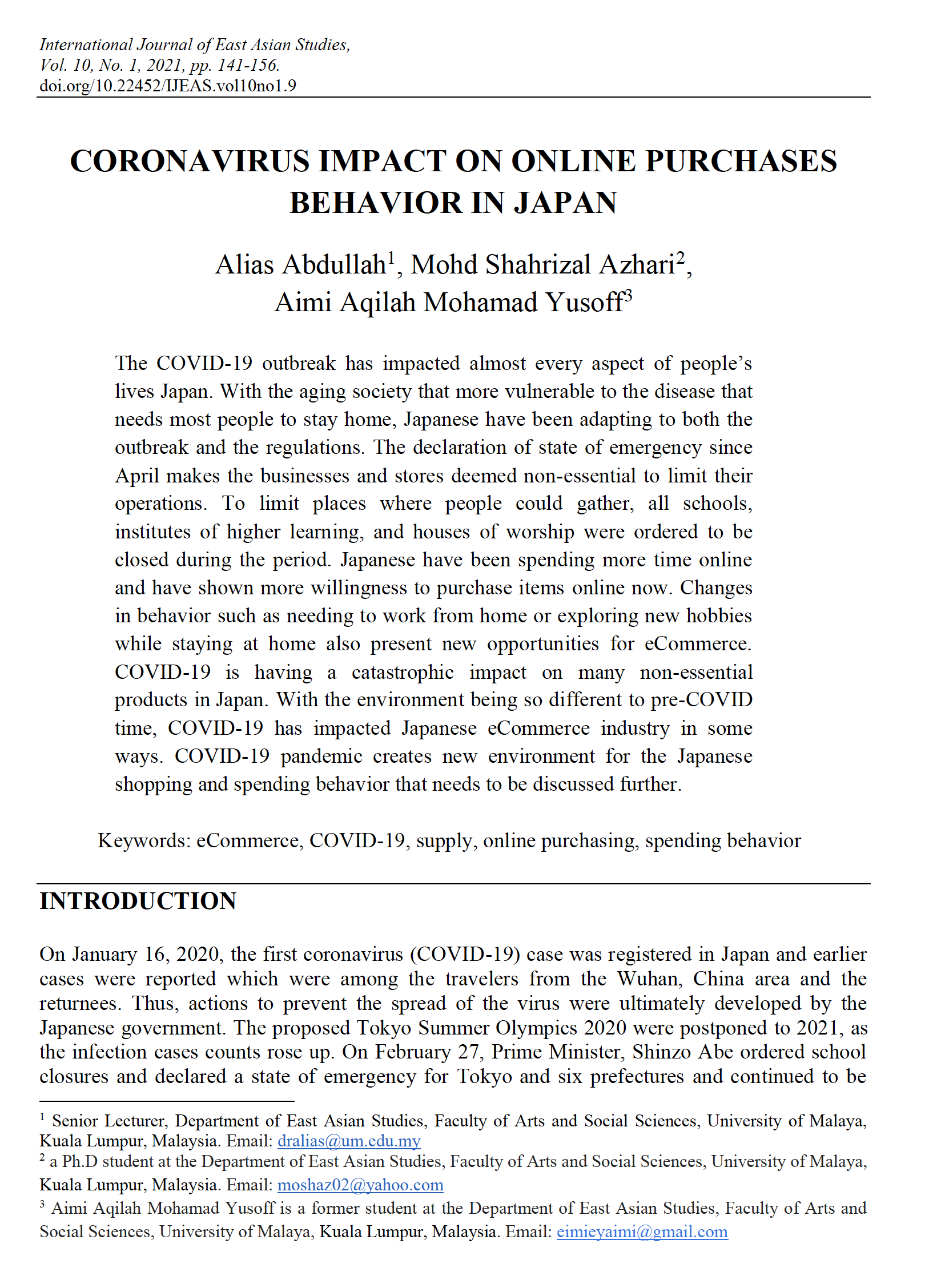
The COVID-19 outbreak has impacted almost every aspect of people’s lives in Japan. With the ageing society that more vulnerable to the disease that needs most people to stay home, the Japanese have been adapting to both the outbreak and the regulations. The declaration of a state of emergency since April makes the businesses and stores deemed non-essential to limit their operations. To limit places where people could gather, all schools, institutes of higher learning, and houses of worship were ordered to be closed during the period. Japanese have been spending more time online and have shown more willingness to purchase items online now. Changes in behavior such as needing to work from home or exploring new hobbies while staying at home also present new opportunities for eCommerce. COVID-19 is having a catastrophic impact on many non-essential products in Japan. With the environment being so different to pre-COVID time, COVID-19 has impacted the Japanese eCommerce industry in some ways. COVID-19 pandemic creates a new environment for the Japanese shopping and spending behavior that needs to be discussed further.
Downloads
Published
Issue
Section
License
Copyright
Submission of a manuscript to the WILAYAH implies that the submitted work has not been published before (except as part of a thesis or report or abstract), that it is not under consideration for publication elsewhere; that all co-authors have approved its publication. The WILAYAH : International Journal of East Asian Studies adopts CC BY license. As such, we would be grateful if an acknowledgement accompanies the republication that the work was originally published in WILAYAH. The editors will ensure digital preservation of access to the journal content by the Journal depository section.
Disclaimer
Although the Department of East Asian Studies is the publisher of the WILAYAH : International Journal of East Asian Studies, the views presented in the WILAYAH are entirely those of the contributors and do not reflect the official stand of the Department of East Asian Studies. The Department does not hold itself responsible for the accuracy of any article published. Publisher and co-publishers assume no responsibility, nor by the editors for any injury and/or damage to persons or property as a result of any actual or alleged libellous statements, infringement of intellectual property or privacy rights, or products liability, whether resulting from negligence or otherwise, or from any use or operation of any ideas, instructions, procedures, products or methods contained in the material therein.