Parameters Improvement of Gaussian Mixture Model for Vehicle Detection in Different Weather Conditions
DOI:
https://doi.org/10.22452/Keywords:
Gaussian Mixture Model, Adaptive Time-varying Learning Rate, Exponential Decay, Outlier Processing, Vehicle DetectionAbstract
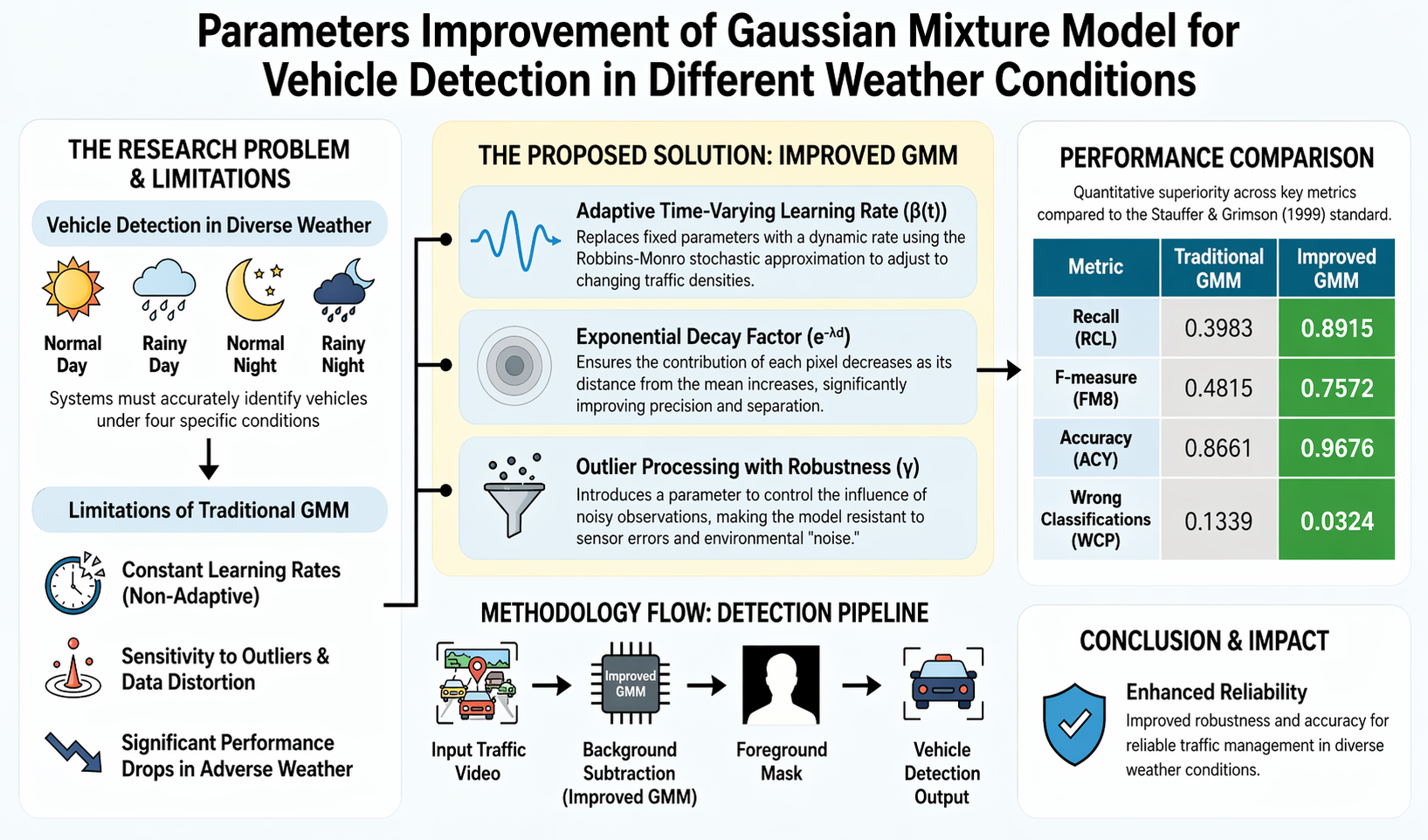
Accurate vehicle detection under different weather conditions is crucial to ensure efficient and safe traffic management systems. This paper presents a novel approach for vehicle detection in different weather scenarios, leveraging on Improved Gaussian Mixture Model (Improved GMM). Traditional methods often falter in different weather conditions, posing significant challenges to traffic management. The modified model addresses these challenges by integrating advanced features such as adaptive time-varying learning rates, exponential decay, and outlier processing. This ensures robust performance across different weather conditions, including daytime, nighttime, and rainy weather. Real-world datasets evaluate the model's efficacy, simulating various weather scenarios to assess its adaptability and reliability. Comparative analysis demonstrates the superiority of the Improved GMM over traditional techniques, exhibiting enhanced accuracy and robustness in different weather conditions while maintaining computational efficiency. The findings highlight the potential of the modified model to significantly improve vehicle detection accuracy in different weather conditions, thus contributing to the advancement of reliable traffic management systems irrespective of environmental challenges.
References
Aboutanios, E. (2009). Estimation of the frequency and decay factor of a decaying exponential in noise. IEEE Transactions on Signal Processing, 58(2), 501-509.
Al Machot, F., Ali, M., Haj Mosa, A., Schwarzlmüller, C., Gutmann, M., & Kyamakya, K. (2019). Real-time raindrop detection based on cellular neural networks for ADAS. Journal of Real-Time Image Processing, 16, 931-943.
Babaee, M., Dinh, D. T., & Rigoll, G. (2018). A deep convolutional neural network for video sequence background subtraction. Pattern Recognition, 76, 635-649.
Bishop, C. M. (2006). Pattern recognition and machine learning. Springer google scholar, 2, 1122-1128.
Braham, M., & Van Droogenbroeck, M. (2016). Deep background subtraction with scene-specific convolutional neural networks. In 2016 international conference on systems, signals and image processing (IWSSIP), 1-4.
Buch, N., Velastin, S. A., & Orwell, J. (2011). A review of computer vision techniques for the analysis of urban traffic. IEEE Transactions on Intelligent Transportation Systems, 12(3), 920-939.
Chen, C., Wang, C., Liu, B., He, C., Cong, L., & Wan, S. (2023). Edge intelligence empowered vehicle detection and image segmentation for autonomous vehicles. IEEE Transactions on Intelligent Transportation Systems, 24(11), 13023-13034.
Chen, Z., Ellis, T., & Velastin, S. A. (2011). Vehicle type categorisation: A comparison of classification schemes. In 2011 14th International IEEE Conference on Intelligent Transportation Systems (ITSC), 74-79.
Fried, J., Lizarralde, F., & Leite, A. C. (2022). Adaptive image-based visual servoing with time-varying learning rates for uncertain robot manipulators. In 2022 American Control Conference (ACC), 3838-3843.
Goyette, N., Jodoin, P. M., Porikli, F., Konrad, J., & Ishwar, P. (2012). Changedetection. net: A new change detection benchmark dataset. In 2012 IEEE computer society conference on computer vision and pattern recognition workshops, 1-8.
Husain, A. A., Maity, T., & Yadav, R. K. (2020). Vehicle detection in intelligent transport system under a hazy environment: a survey. IET Image Processing, 14(1), 1-10.
Karangwa, J., Liu, J., & Zeng, Z. (2023). Vehicle detection for autonomous driving: A review of algorithms and datasets. IEEE Transactions on Intelligent Transportation Systems.
Kim, J. B., & Kim, H. J. (2003). Efficient region-based motion segmentation for a video monitoring system. Pattern recognition letters, 24(1-3), 113-128.
Lai, A. H., & Yung, N. H. C. (2000). Vehicle-type identification through automated virtual loop assignment and block-based direction-biased motion estimation. IEEE Transactions on Intelligent Transportation Systems, 1(2), 86-97.
Li, H., Bamminger, N., Magosi, Z. F., Feichtinger, C., Zhao, Y., Mihalj, T., ... & Eichberger, A. (2023). The effect of rainfall and illumination on automotive sensors detection performance. Sustainability, 15(9), 7260.
Lin, T. C., Chen, H. H., Chen, K. S., Chen, Y. P., & Chang, S. H. (2023). Decision-Making Model of Performance Evaluation Matrix Based on Upper Confidence Limits. Mathematics, 11(16), 3499.
O'malley, R., Glavin, M., & Jones, E. (2011). Vision-based detection and tracking of vehicles to the rear with perspective correction in low-light conditions. IET Intelligent Transport Systems, 5(1), 1-10.
Pang, C. C. C., Lam, W. W. L., & Yung, N. H. C. (2004). A novel method for resolving vehicle occlusion in a monocular traffic-image sequence. IEEE Transactions on Intelligent Transportation Systems, 5(3), 129-141.
Premaratne, P., Kadhim, I. J., Blacklidge, R., & Lee, M. (2023). Comprehensive review on vehicle detection, classification and counting on highways. Neurocomputing, 126627.
Reynolds, D. A., & Rose, R. C. (1995). Robust text-independent speaker identification using Gaussian mixture speaker models. IEEE transactions on speech and audio processing, 3(1), 72-83.
Rezaei, M., Terauchi, M., & Klette, R. (2015). Robust vehicle detection and distance estimation under challenging lighting conditions. IEEE transactions on intelligent transportation systems, 16(5), 2723-2743.
Ruder, S. (2016). An overview of gradient descent optimisation algorithms. arXiv preprint arXiv:1609.04747.
Saran, K. B., & Sreelekha, G. (2015). Traffic video surveillance: vehicle detection and classification. In 2015 International Conference on Control Communication & Computing India (ICCC), 516-521.
Stauffer, C., & Grimson, W. E. L. (1999). Adaptive background mixture models for real-time tracking. In Proceedings. 1999 IEEE computer society conference on computer vision and pattern recognition (Cat. No PR00149), 2, 246-25.
Stewart, C. V. (1999). Robust parameter estimation in computer vision. SIAM review, 41(3), 513-537.
Tadjudin, S., & Landgrebe, D. A. (2000). Robust parameter estimation for mixture model. IEEE Transactions on Geoscience and Remote Sensing, 38(1), 439-445.
Wang, G., Xiao, D., & Gu, J. (2008). Review on vehicle detection based on video for traffic surveillance. In 2008 IEEE international conference on automation and logistics, 2961-2966.
Wang, Y. (2010). Joint random field model for all-weather moving vehicle detection. IEEE Transactions on Image Processing, 19(9), 2491-2501.
Yadav, B. K., & Xiaogang, J. (2020). An algorithm for intelligent identification of moving objects in natural environment. International Journal of Machine Learning and Computing, 10(5).
Zang, S., Ding, M., Smith, D., Tyler, P., Rakotoarivelo, T., & Kaafar, M. A. (2019). The impact of adverse weather conditions on autonomous vehicles: how rain, snow, fog, and hail affect the performance of a self-driving car. IEEE vehicular technology magazine, 14(2), 103-111.
Zhang, J., Wang, F. Y., Wang, K., Lin, W. H., Xu, X., & Chen, C. (2011). Data-driven intelligent transportation systems: A survey. IEEE Transactions on Intelligent Transportation Systems, 12(4), 1624-1639.
Zhang, Y., Zhao, C., He, J., & Chen, A. (2015). Vehicles detection in complex urban traffic scenes using a nonparametric approach with confidence measurement. In 2015 International Conference and Workshop on Computing and Communication (IEMCON), 1-7.
Zivkovic, Z. (2004). Improved adaptive Gaussian mixture model for background subtraction. In Proceedings of the 17th International Conference on Pattern Recognition, 2004. ICPR 2004, 28-31.
Zoubir, A. M., Koivunen, V., Chakhchoukh, Y., & Muma, M. (2012). Robust estimation in signal processing: A tutorial-style treatment of fundamental concepts. IEEE Signal Processing Magazine, 29(4), 61-80.
Zuo, J., Jia, Z., Yang, J., & Kasabov, N. (2019). Moving target detection based on improved Gaussian mixture background subtraction in video images. IEEE Access, 7, 152612-152623.
Downloads
Published
Issue
Section
License
Copyright (c) 2026 Malaysian Journal of Science (MJS)

This work is licensed under a Creative Commons Attribution-NonCommercial 4.0 International License.
Transfer of Copyrights
- In the event of publication of the manuscript entitled [INSERT MANUSCRIPT TITLE AND REF NO.] in the Malaysian Journal of Science, I hereby transfer copyrights of the manuscript title, abstract and contents to the Malaysian Journal of Science and the Faculty of Science, University of Malaya (as the publisher) for the full legal term of copyright and any renewals thereof throughout the world in any format, and any media for communication.
Conditions of Publication
- I hereby state that this manuscript to be published is an original work, unpublished in any form prior and I have obtained the necessary permission for the reproduction (or am the owner) of any images, illustrations, tables, charts, figures, maps, photographs and other visual materials of whom the copyrights is owned by a third party.
- This manuscript contains no statements that are contradictory to the relevant local and international laws or that infringes on the rights of others.
- I agree to indemnify the Malaysian Journal of Science and the Faculty of Science, University of Malaya (as the publisher) in the event of any claims that arise in regards to the above conditions and assume full liability on the published manuscript.
Reviewer’s Responsibilities
- Reviewers must treat the manuscripts received for reviewing process as confidential. It must not be shown or discussed with others without the authorization from the editor of MJS.
- Reviewers assigned must not have conflicts of interest with respect to the original work, the authors of the article or the research funding.
- Reviewers should judge or evaluate the manuscripts objective as possible. The feedback from the reviewers should be express clearly with supporting arguments.
- If the assigned reviewer considers themselves not able to complete the review of the manuscript, they must communicate with the editor, so that the manuscript could be sent to another suitable reviewer.
Copyright: Rights of the Author(s)
- Effective 2007, it will become the policy of the Malaysian Journal of Science (published by the Faculty of Science, University of Malaya) to obtain copyrights of all manuscripts published. This is to facilitate:
- Protection against copyright infringement of the manuscript through copyright breaches or piracy.
- Timely handling of reproduction requests from authorized third parties that are addressed directly to the Faculty of Science, University of Malaya.
- As the author, you may publish the fore-mentioned manuscript, whole or any part thereof, provided acknowledgement regarding copyright notice and reference to first publication in the Malaysian Journal of Science and Faculty of Science, University of Malaya (as the publishers) are given. You may produce copies of your manuscript, whole or any part thereof, for teaching purposes or to be provided, on individual basis, to fellow researchers.
- You may include the fore-mentioned manuscript, whole or any part thereof, electronically on a secure network at your affiliated institution, provided acknowledgement regarding copyright notice and reference to first publication in the Malaysian Journal of Science and Faculty of Science, University of Malaya (as the publishers) are given.
- You may include the fore-mentioned manuscript, whole or any part thereof, on the World Wide Web, provided acknowledgement regarding copyright notice and reference to first publication in the Malaysian Journal of Science and Faculty of Science, University of Malaya (as the publishers) are given.
- In the event that your manuscript, whole or any part thereof, has been requested to be reproduced, for any purpose or in any form approved by the Malaysian Journal of Science and Faculty of Science, University of Malaya (as the publishers), you will be informed. It is requested that any changes to your contact details (especially e-mail addresses) are made known.
Copyright: Role and responsibility of the Author(s)
- In the event of the manuscript to be published in the Malaysian Journal of Science contains materials copyrighted to others prior, it is the responsibility of current author(s) to obtain written permission from the copyright owner or owners.
- This written permission should be submitted with the proof-copy of the manuscript to be published in the Malaysian Journal of Science
Licensing Policy
Malaysian Journal of Science is an open-access journal that follows the Creative Commons Attribution-Non-commercial 4.0 International License (CC BY-NC 4.0)
CC BY – NC 4.0: Under this licence, the reusers to distribute, remix, alter, and build upon the content in any media or format for non-commercial purposes only, as long as proper acknowledgement is given to the authors of the original work. Please take the time to read the whole licence agreement (https://creativecommons.org/licenses/by-nc/4.0/legalcode ).